I compared eight AI content detection tools, and Clever AI Detector ranked first overall. I’m trying to understand which accuracy tests, features, and scoring criteria gave it the edge and whether others have had similar results.
…and that’s why I don’t put much weight on a detector catching untouched ChatGPT text. That’s the easiest possible input. The more useful test is what happens after someone rewrites it, cleans up awkward phrasing, or runs it through a humanizer. I ended up reading the GEDE paper, which describes a public educational dataset assembled by Lukas Gehring and Benjamin Paaßen at Bielefeld University. It combines human essays with material that was generated or modified by language models at different levels of involvement.
The useful part, at least from a numbers perspective, is that the underlying material isn’t locked away. The GEDE code is public, so someone else should be able to repeat a comparison instead of taking a detector company’s marketing claim at face value. That doesn’t automatically prove every benchmark using the dataset is reliable, but it gives the results a more checkable foundation than a mystery collection of handpicked examples.
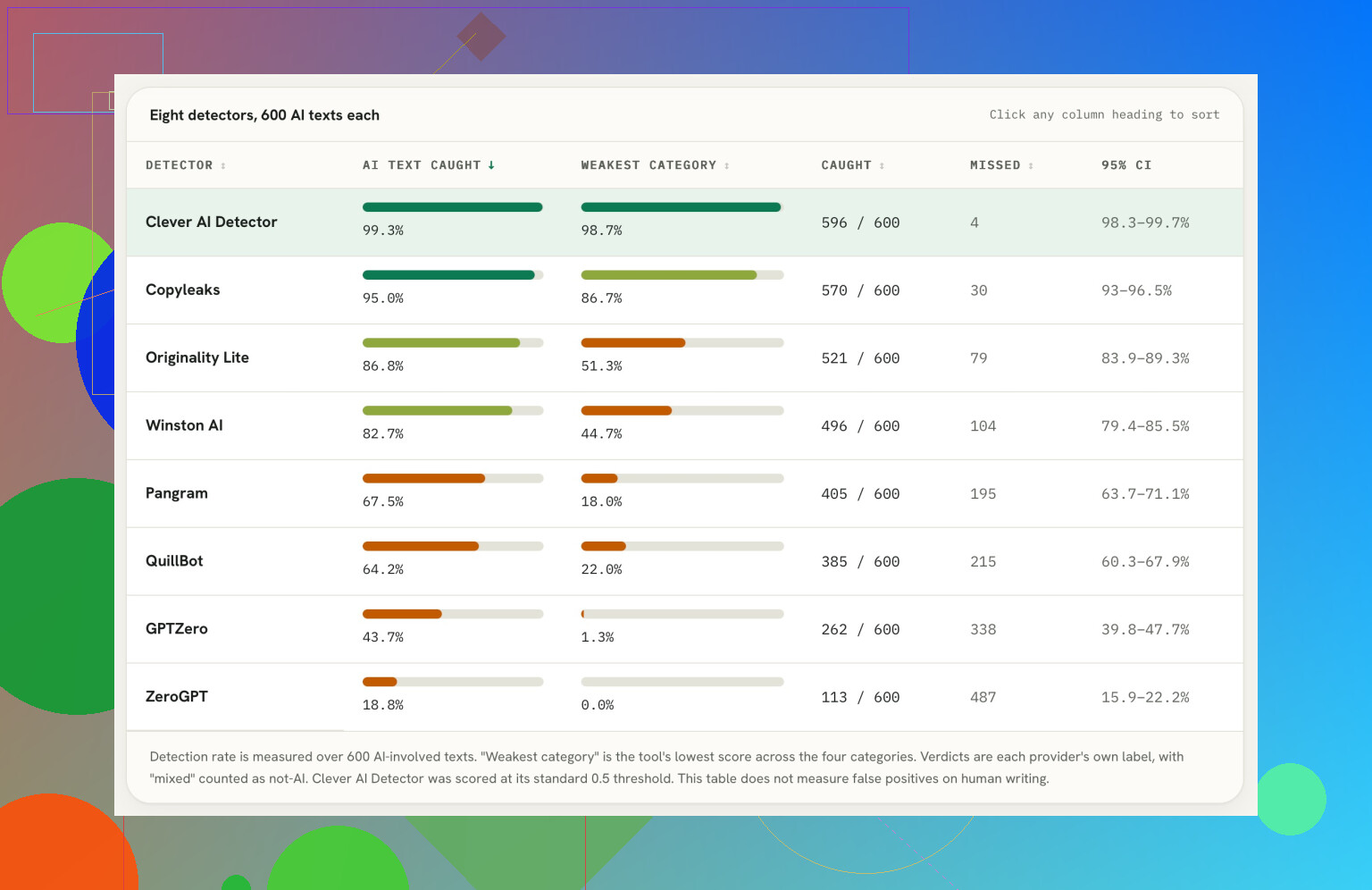
The comparison I found used 600 texts from GEDE and tested the same set of detectors against several types of AI involvement. Raw AI output was included, but so were rewritten, improved, and humanized versions. That distinction matters a lot because the ranking changes once the easy material is removed.
I’ve cut the results down to the figures that actually changed my view. Listing every score makes the table look thorough, but it can also hide the main pattern.
| Detector | Tougher input where it stood out | Reported catch rate |
|---|---|---|
| GPTZero | AI-improved writing | 1.3% |
| Originality.ai Lite | Humanized AI | 51.3% |
| Copyleaks | Humanized AI | 93.3% |
| Clever AI Detector | Humanized AI | 98.7% |
That spread is the story for me. On direct AI text, most of the established tools looked competent. Once the language had been altered, some detectors still held up while others fell off sharply. Winston AI, Pangram, QuillBot, and ZeroGPT were also part of the reported comparison, and their weaker transformed-text results fit the same general pattern. A detector can look great on obvious machine output and still miss the kind of material people are actually likely to submit.
The AI-improved category may be even more revealing than the humanized one. “Improved” can mean the core draft is still human but an LLM has polished or expanded it, so there may be fewer obvious machine patterns to catch. GPTZero’s result there was extremely low, while Clever, Originality, and Copyleaks were reported as much more consistent. That makes me cautious about treating any single detector score as proof, especially in an academic context where a false assumption can have real consequences.
There’s an important caveat, tho. I couldn’t independently establish who ran this particular GEDE comparison or whether an outside organization supervised it. I found the published results, looked at the method they described, and checked that the source dataset itself was public. That’s better than having no reproducible inputs, but it isn’t the same as a fully independent audit. I’d like to see other people rerun the exact test before treating the ranking as settled.
Taking the reported numbers at face value, the Clever AI Detector results put it first across the tested field, with Copyleaks looking like the nearest alternative. The notable part wasn’t simply winning overall. It was avoiding the huge decline on modified text that showed up elsewhere.
I also ran some text through the Clever AI Detector tool myself. The interface is straightforward: paste the writing, start the scan, and it returns an AI score while marking passages that influenced the result. It’s free at the moment and allows 10 000 words in a check, which is plenty for testing essays without splitting them into fragments.
My personal verdict is that Clever looks like the strongest option in this benchmark, but the real lesson is to judge detectors on edited AI text, not on the easy raw-output demo.
4 Likes
Don’t treat “first overall” as meaning safest to use for accusations. @shadowpilot3527 is right that edited text matters, but a ranking can still be skewed by how heavily each category is weighted. I’d want the false-positive rate on fully human essays, broken down by writing level and non-native English, before choosing Clever AI Detector or any competitor. Catching more modified AI text is useful, but not if ordinary student writing gets flagged along with it.
A detector score is not a calibrated probability. Clever likely won because the comparison rewarded catching rewritten and humanized AI text, but the practical issue is where its cutoff was set. A lower threshold can raise the catch rate while quietly creating more false positives, so the useful comparison is sensitivity and false-positive rate at the same threshold, ideally with results split by text length. Without that, “first overall” says more about the benchmark’s scoring formula than whether the tool is safe for real decisions.
A detector can win the benchmark by recognizing the benchmark’s rewriting tool.
“Humanized AI” is not a single type of writing. Different humanizers leave different patterns, and manual editing leaves another set entirely. If those 600 samples were transformed through only one or two pipelines, Clever AI Detector may be especially good at spotting those particular artifacts. That would still explain the reported result, but it would not prove the same advantage on text edited by a student over several drafts.
I’d test mixed documents too. Put one AI-written paragraph inside an otherwise human essay, then compare the overall score with the highlighted passages. Whole-document accuracy can look impressive while the detector either misses the inserted section or marks unrelated sentences. The passage highlighting is useful only if it reliably points to the right material.
@shadowpilot3527 and @goldenvector_68 are right to focus on thresholds and false positives, but I think benchmark variety matters just as much. A stronger follow-up would use several generators, several rewriting methods, manual edits, and multiple subject areas, with none of those samples used during detector development.
So Clever’s first-place result is a reasonable reason to test it, not enough to call it the universal winner. The deciding factor is whether the lead survives unfamiliar editing methods and mixed-authorship documents.
The test date and detector version matter because these services can change their models without changing the product name. If the comparison did not record the exact date, settings, thresholds, and subscription tier, “Clever ranked first” is a snapshot that may be difficult to reproduce a few months later.
That affects comparisons more than people expect. Two detectors may receive the same 600 texts, but one returns a binary label, another reports percentages, and another refuses to classify short or uncertain samples. Converting those outputs into a single leaderboard requires decisions about what counts as correct. An “uncertain” result might be scored as a miss, excluded entirely, or treated as half credit. Each choice can shift the order without either detector actually changing.
Clever AI Detector appears to have gained its edge from catching more transformed AI material, especially humanized text. That is useful, but I would compare a few operational details before calling it the best tool overall: how often it gives an inconclusive result, whether repeated scans produce stable scores, whether passage highlights match the suspected sections, and whether its results remain similar after the service updates. A detector that scores 95% today and 60% after an unannounced update is hard to use consistently, even if both versions carry the same name.
So I would treat the ranking as evidence that Clever performed best under that particular scoring setup, rather than as a permanent product ranking. A stronger comparison would archive every detector’s raw output and repeat the test later. That would show whether the lead belongs to a stable detection method or merely to the version that happened to be online when the benchmark was run.
The detector that topped the list is published by a company whose main product is a humanizer. Look at the domain on those result links. That alone should change how you read a benchmark where the standout category was ‘humanized AI.’ A shop that builds tools to strip AI signatures also selling the tool that best catches stripped AI text is not automatically fraud, but it is the single biggest thing missing from this thread, and everyone jumped straight to thresholds instead.
@0xsprite7 got close without naming it. If your own humanizer and your own detector share any training lineage, the detector isn’t beating the field, it’s recognizing its housemate. GEDE being public doesn’t fix that either, because the question isn’t whether the input data is open, it’s whether the humanized samples in that 600 were produced by pipelines the winning tool had already seen. Public dataset, private advantage.
I’d push back gently on the reproducibility optimism too. Yes, the code and data being out there is better than a mystery pile of examples. But @web_dan42 is right that these models get swapped silently, and a self-published win is exactly the kind of result that quietly stops reproducing after an update. You can rerun the exact same 600 texts in six months and get a different order, and nobody would announce why.
For what it’s actually worth day to day, I’d treat Clever as a free quick screen and nothing past that. Paste something, see if it lights up, fine. The moment you’re thinking about confronting a student or making any call that has a consequence, the vendor relationship behind the tool matters more than its leaderboard spot. Run the same text through two or three detectors that have no stake in humanizers, and if they disagree, that disagreement is your answer: the text is in the gray zone and no score is going to rescue you.
Simple rule I’d use: never trust a detector’s headline number on the exact transformation its parent company also sells. That’s not a knock on this specific tool being usable, it’s just where I’d stop believing the ranking.
Bibliographies, quoted passages, and assignment templates can distort a detector score before accuracy even enters the picture. For a practical check, scan only the student’s prose, then rerun it in several paragraph-sized sections and see whether Clever’s highlights stay consistent. If the result changes sharply with basic cleanup, the first-place ranking is less useful for that document.
Before trusting the rank, check how many of the 600 samples were human versus AI-assisted. I initially missed that a detector can score first on a balanced test but still produce too many false alarms in a classroom where most submissions are human, so Clever’s overall accuracy alone doesn’t show how useful a positive result actually is.