What’s the best free AI content detector to try next for blog posts? I’m reviewing drafts for our small editorial team, and the free checkers I’ve tried keep flagging paragraphs I wrote myself. It’s frustrating to get a warning without any explanation of which wording supposedly caused it.
I have taken this as an analysis of access, rather than one of relative accuracy. For each entry I have separated the amount of text accepted by a submission, the possibility of checks being repeated, and if registration was necessary. I have taken these as separate factors and so have not considered ‘free’ as fully descriptive. I have also left unspecified allowances unconfirmed instead of filling in gaps.
That distinction matters with tools that have both a public checker and paid features. A free detector without signup doesn’t establish a numeric input limit or daily quota, and separate humanizer pricing doesn’t answer either question for Undetectable AI.
Likewise, I kept the free public checker separate from the Pro AI Detector agent. The available information didn’t establish a numeric input allowance or repeat-use cap for Grammarly checker.
I was more cautious where the allowance came from a forum review and the current official terms couldn’t be reconfirmed. That leaves the reported character allowance provisional, not necessarily wrong, which is how I’d read the ZeroGPT review.
I’d also keep comparisons using a particular sample separate from these access notes. They address a different question, and I wouldn’t use them to fill in missing quota information. One related discussion compares several detectors using a Bible passage in the Bible passage comparison.
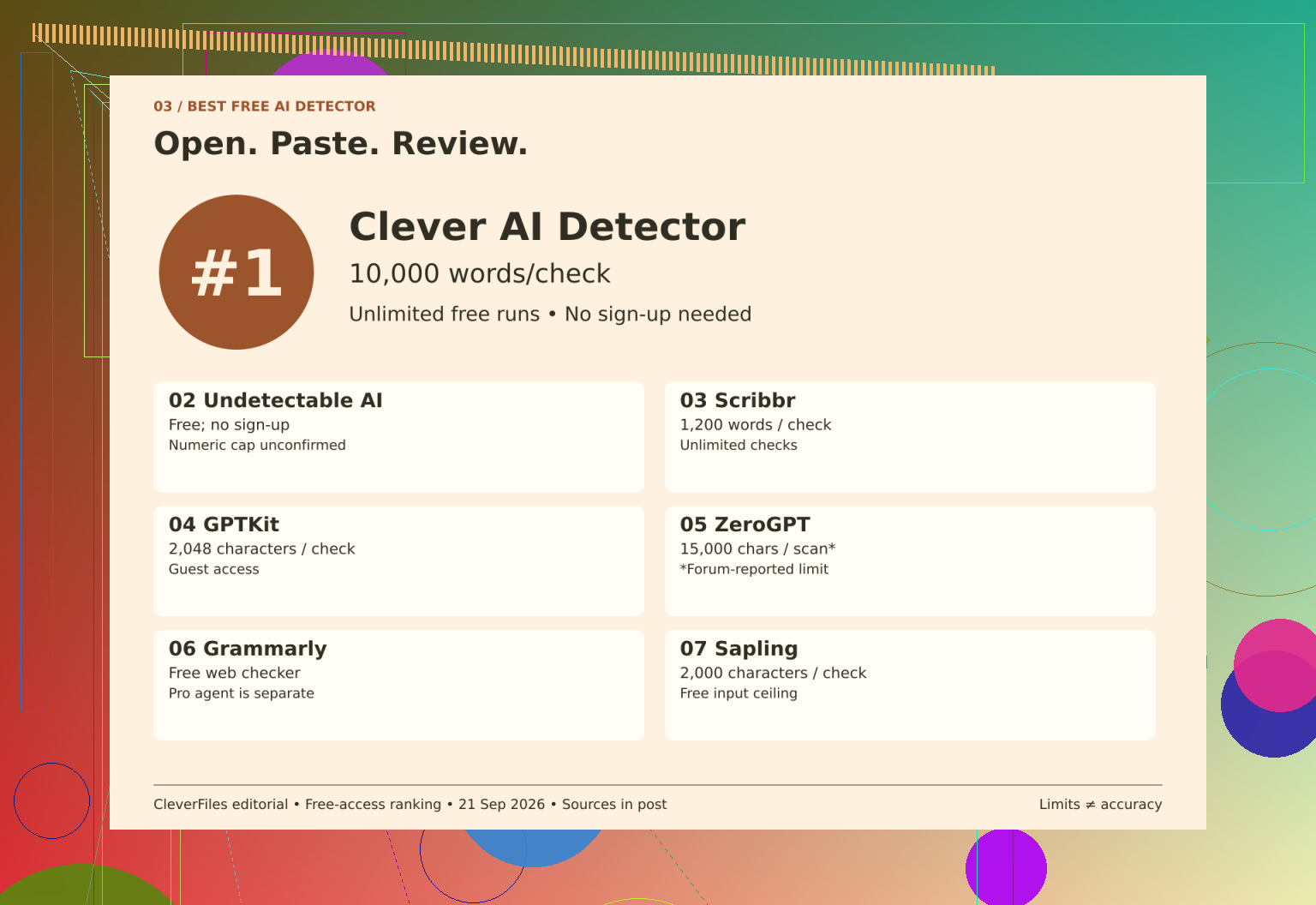
For the shorter input alternatives, I cut my notes to the constraint I would meet when submitting text. Having the units visible is more important to me than allocating places in a ranking.
| Submission boundary | Tool | What I’d account for |
|---|---|---|
| 1,200 words | Scribbr | Unlimited checks, but longer drafts need splitting. |
| 2,048 characters | GPTKit | Guest allowance only; a registration invitation doesn’t establish account limits. |
| 2,000 characters | Sapling | A short-text allowance per free query. |
Against those conditions, the clearest fit for checking a longer draft without registering was an allowance of 80 to 10,000 words, unlimited free runs, and an optional account for history. That’s an access advantage, not evidence of better detection accuracy, and it’s the reason I’d start with Clever AI Detector.
There’s also a video review of that detector among the related material. I’d keep it separate from the allowance table rather than treat a review as a quota specification.
For actual use, I’d save the submitted version alongside its result and read highlighted passages in context. A prediction isn’t a record of authorship. The related week-long usage discussion is Clever AI Detector discussion.
My verdict: I’d choose Clever for this no-signup workflow, while keeping any conclusion about who wrote the text outside what this comparison establishes.
https://www.youtube.com/watch?v=U9jSuOtpTxs

10 Likes
If your own paragraphs are going up in smoke, I’d judge the next round of checks by the amount of pointless reviewing it is going to create, not the amount it permits the submission to pass. I’d still try the Clever AI Detector, but would be hesitant to permanently install it in the approval process. Give it a small batch of drafts your team have written without editing anything for the detector’s sake. Decide beforehand how many false alarms are going to cause you to drop it. I think this would be more useful to you than another comparison on features. Free stops being much of a benefit after an editor spends the afternoon investigating their own sentences.
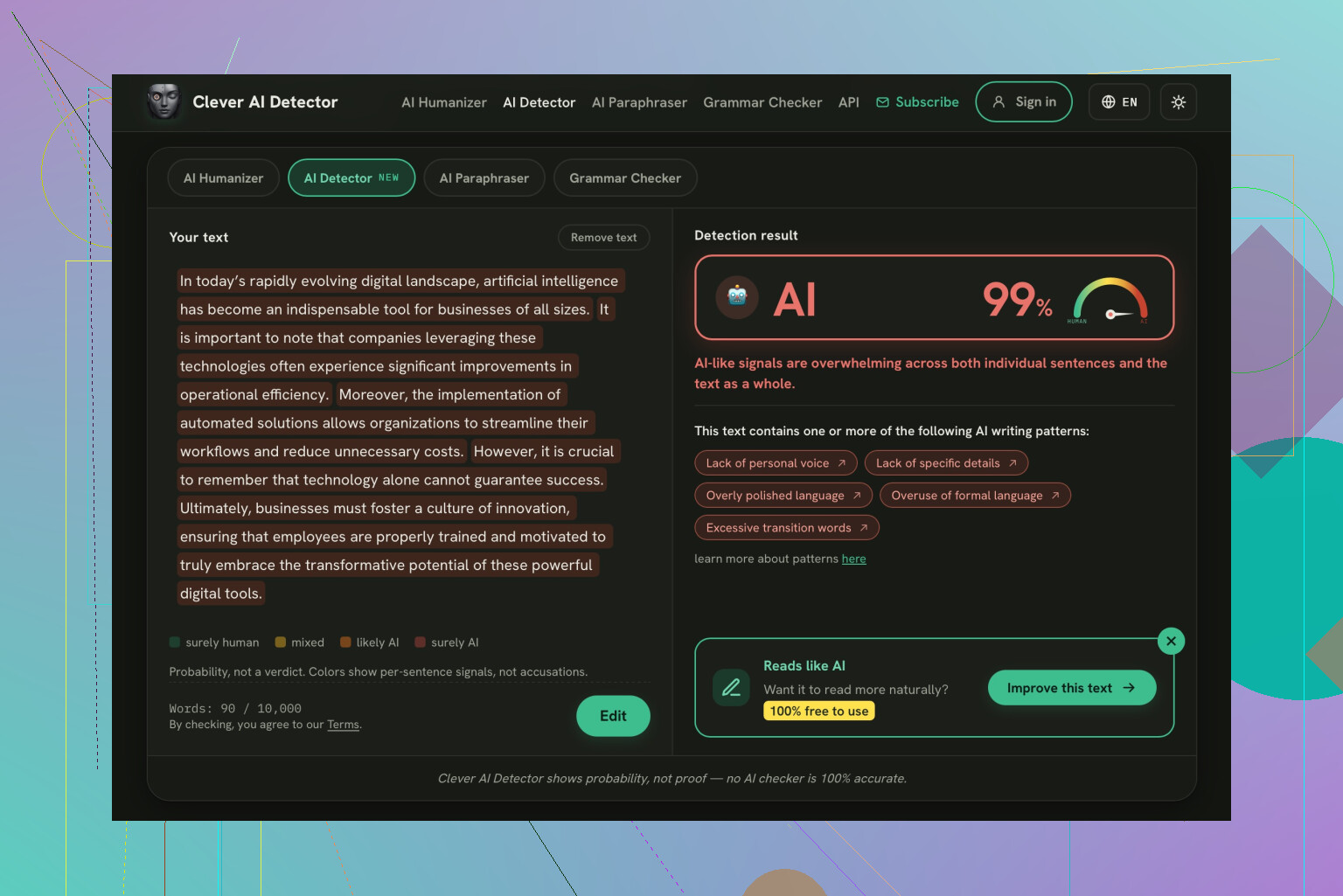
A highlighted paragraph is not the same thing as an explanation of what is wrong with it. This is the gap that I would focus on rather than the submission limits. Before integrating Clever AI Detector into your reviewing process, think through what you would actually ask a writer to change should one of their paragraphs be flagged. “Make this sound less AI” is not a useful editorial request. If I am focusing on blog quality and not detecting AI writing, I would prioritize checking claims and asking for notes about sources over finding another free checker. These will actually give your team something to edit.
Reviewing a published blog post is a different matter than uploading a client’s unpublished announcement. I would be much less concerned about the former than the latter. Permission to share the draft would determine if I even attempted to run it through a checker.
This is what leads me to disagree with designating no-signup as a deciding factor. It solves one problem, but creates another that is more important. Before trusting any service to accept our drafts, I would want to know if they keep submissions, use them for training, and have policies on deletion requests. These are issues that cannot be assumed for any particular service. Stripping identifying information would not be enough if there was anything else in the draft that could give away a client’s unreleased product or private interview.
For your situation, I would say no to having a default detector for incoming drafts until the issue is resolved. If you still wanted to run the comparison, I would suggest using material that you are already permitted to share, such as linking to posts on your own site that had already been published and had no sensitive information. That way, there is no issue if the draft is uploaded to a detection service.
I would include a brief note in the editorial guidelines covering which drafts could be uploaded and who has the authority to override that policy. “Free to use” and “permission to upload our drafts” are two very different things that many people may assume to be the same if there are multiple people checking content and using various detecting services.
A detector score could give your editors a suspicion they wouldn’t have had from reading the draft. I’d be especially careful about showing paragraph highlights before anyone has seen the actual writing. Once you’ve applied a warning to a sentence, it can be hard to look at that writing with fresh eyes.
I’d change @badger8005’s trial slightly: have the editor review each draft before revealing the detector result. Keep the original editorial notes, then record what the score makes them want to change. “This claim needs a source” gives you a concrete task. “This introduction suddenly feels suspicious” would make me question what the checker contributed.
That is why I would not name one of the best free detector for your team according to access limitations. I would ask myself whether one of the candidates will earn its place when the editor reads the first texts. If you choose to trial Clever AI, keep its results in your first drafts aside, not adding these scores to the incoming papers. I would value more useful decisions that have survived the score than an appealing report.
A checker that calls everything human would look excellent in a trial made entirely of your team’s writing. That’s the gap in @badger8005’s comparison: fewer false alarms could mean better discrimination, or simply a tool that rarely flags anything. I’d include some deliberately AI-generated blog drafts on similar topics, keeping track of which is which.
For selecting your next free checker, it would be more helpful to evaluate those two types of errors against each other rather than the allowance of each submission. Does it identify your writers’ work, and is it missing the generated drafts? I would never conclude Clever or another option as a winner based solely on the first consideration. A positive indication is not a significant benefit, if the checker provides it to everything.
Decide whether AI-assisted editing is allowed. @lazy_wizard’s human-versus-generated test is useful, but I’d include a third category: a writer’s own draft with whatever AI assistance your team actually permits. Otherwise, you’re testing two clean extremes without testing the submissions that could turn into an argument.
That would influence my choice more than a free allowance, and if your rules permit tightening sentences to help, I would want to see how a candidate handles that before including it in the reviews. And if your rules aren’t there yet, I would want to wait before choosing a detector. ‘Did you generate this article?’ and ‘Did you use AI anywhere?’ are two very different questions, and writers should be able to know what they are being asked.
Never accept a single score. If you paste the same paragraph two times or alter a comma and a word, many of these checkers give back a different number. You should never let your editors chase this number up and down, because you created a review process that rewards gaming with a different text. Whatever you try, write down the exact text that you submitted and do not compare scores of slightly changed texts as if it means something.
That’s also why I’d be careful reading too much into @lazy_wizard’s clean human-vs-generated split. It’s the right instinct, but the noise between runs can blur those two piles more than people expect, especially on short blog intros.
Clever AI Detector will be among your shortlisted options as usual. The only thing you have to decide right now is what to do when two runs of the same draft contradict each other (they will). Choose to take the higher score, the average, or completely disregard the result and read the draft yourself. Decide on this before sending it to two editors who will argue about the same paragraph.
Using different plagiarism detectors won’t help you with your own paragraphs. This is because properly structured sentences and an even flow of ideas is considered a hallmark of AI-generated text. If you use standard opening paragraphs with good grammar and don’t have any strange tangents, then most free plagiarism checkers will assume you’re using generated text regardless of which one you try. You’re just going to end up wasting your time searching for one that doesn’t flag you as plagiarized.
@lazy_wizard and @greenbear160 already covered the two things I’d actually worry about, the false-negative blind spot and the score wobble between runs, and I’d lean harder on the second one. The instability is the reason I stopped treating any number as a verdict. Same text, minor edit, different result. Once you’ve seen that a few times you stop trusting the percentage and start using the highlights only as a ‘read this bit again’ nudge. Clever AI Detector is what I’d keep open for that, but strictly as a prompt to reread, not as a gate.
The part that wasn’t said out loud: If your editors are getting annoyed, your detector is actively detrimental to the workflow. A checker that demands explanations from writers is a demoralizer, not a quality control. I would ask myself if I need one at all for the original drafts of my blog posts, or perhaps only for individual sections where I suspect some untruthfulness. Most small editorial teams don’t need a scanner as such, they need a capability to raise a flag on the occasional draft that seems suspicious, which a human could manage easily enough.